
System Studies
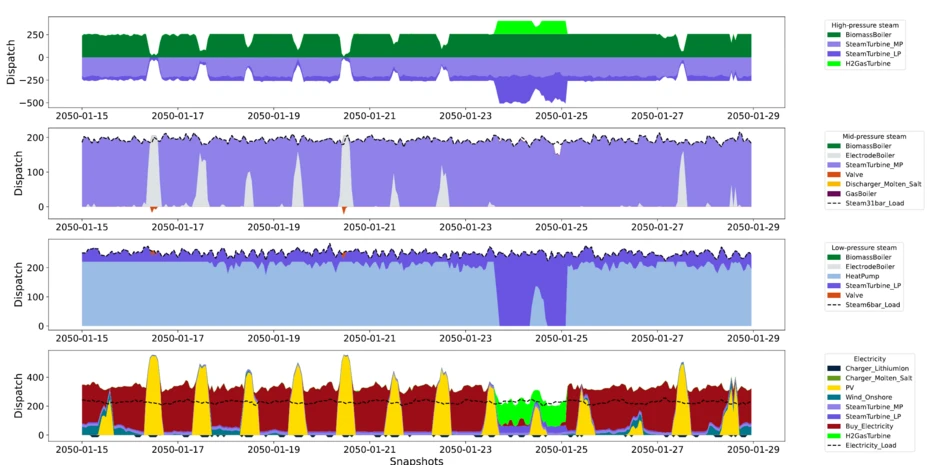
System studies provide a view of the entire energy system. To this end, optimization models are used to examine scenarios for the transformation towards CO2 neutrality.
In addition to the requirements to be covered, energy source costs and potential for the expansion of renewable energies play an important role in projecting both the expansion and deployment planning of future technologies.
Current research in the field of energy system analysis at the Chair is concerned with the transformation of the energy-intensive chemical industry towards CO2 neutrality. In
addition to future energy supply at the site, the conversion of the currently still fossilbased routes of basic chemicals such as methanol, olefins, ammonia, or
sustainable aviation fuels is a central challenge. Of particular interest here are the already emerging conflicts of use of CO2-neutral energy sources such as biomass or
green hydrogen, the competition from imports of these basic chemicals, and the potential of flexible loads as a direct response to temporarily low availability of renewable energies. Techno-economic parameters and experimental studies of
process-specific technologies represent a central input for the modeling. Examples of
this include the technologies researched at the Chair of Carbon Capture, dynamic
methanol synthesis, or chemical recycling using pyrolysis or gasification.
Another research focus is on analyzing the potential of renewable energies and the question of how the carbon cycle can be sustainably closed in the energy system of the future.
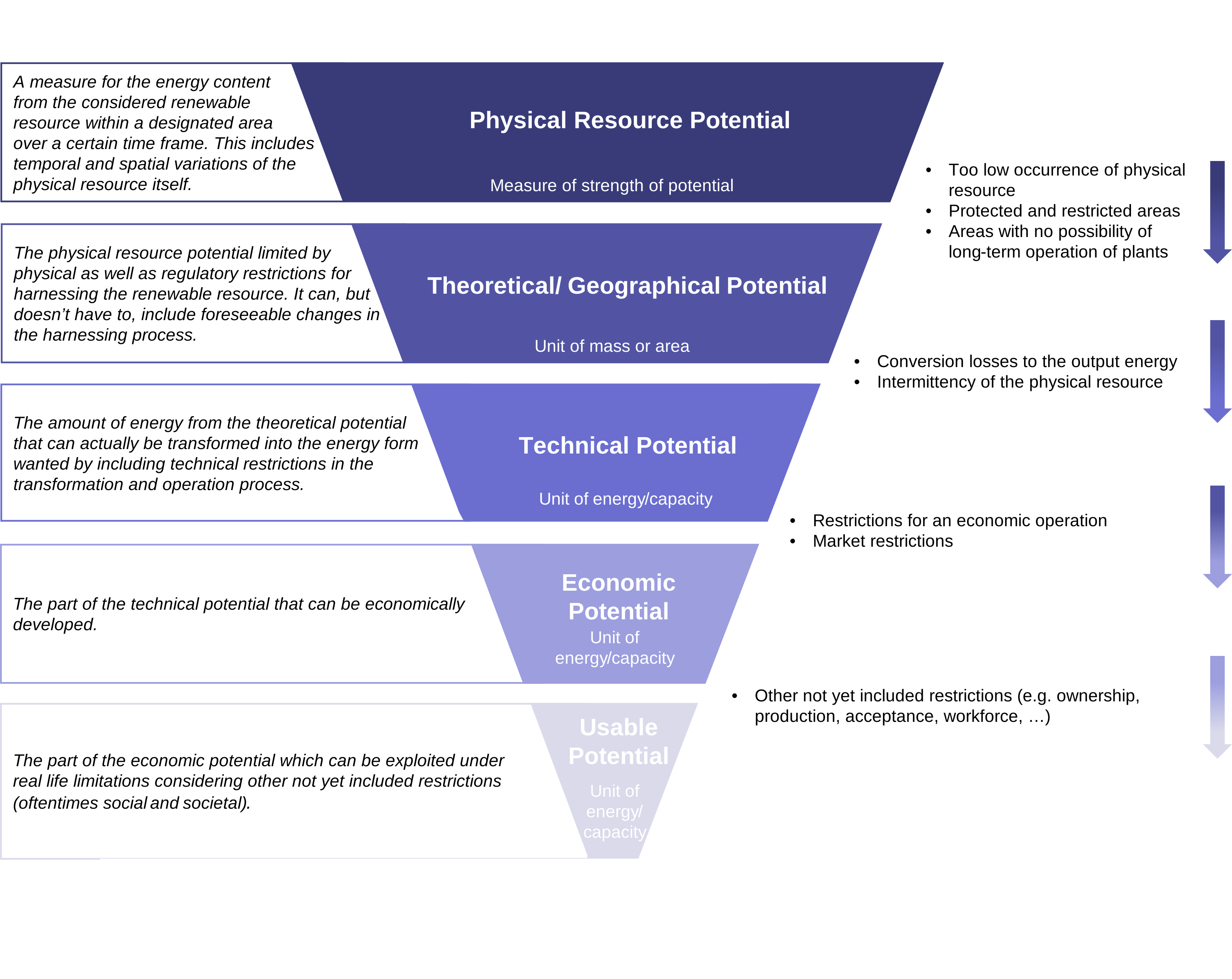
To determine the various potentials, spatially resolved models are developed using geoinformation (GIS) data. Depending on the level of potential, as shown in Figure 1, these models provide information on various limitations of the potential. These can be of a geophysical, technical, political, economic, or social nature.
The spatial resolution of the models is crucial in order to be able to take into account transport phenomena between supply (potential) and demand.
With regard to the carbon cycle, the objective is to identify, quantify, and spatially resolve carbon sources that do not unbalance the carbon cycle. To this end, potential models are created for the four major cornerstones of biogenic residues, other residues, carbon capture from difficult or unavoidable emission sources, and direct air capture.
Projects:
Contact:
Alina Kerschbaum (Potential analyses of renewable energies and potential for a closed carbon cycle)
Maximilian Kerschbaum (Energy system optimization)
Referenzen:
[1] Kerschbaum, Alina and Trentmann, Lennart and Hanel, Andreas and Fendt, Sebastian and Spliethoff, Hartmut, Methods for analysing renewable energy potentials in energy system modelling: A review. 2025, Renewable and Sustainable Energy Reviews, 215, Article 115559. doi.org/10.1016/j.rser.2025.115559