
Processimulation
Process simulation is a very helpful tool for mapping, optimizing, and evaluating process engineering processes. The most important subunits, such as chemical reactors, heat exchangers, or distillation columns, are modeled based on detailed kinetic models, equilibrium models, experimental data, or empirical equations and linked to form overall processes. Common process simulation programs such as Aspen Plus use detailed material databases as a basis and, with the help of a solver, the mass and energy balances for the models of the subunits are solved. From the resulting material and energy flows and the results of the individual plant elements, key parameters such as energy efficiencies or CO2 emissions of processes can be determined. The results can also be used as input values for economic analyses.
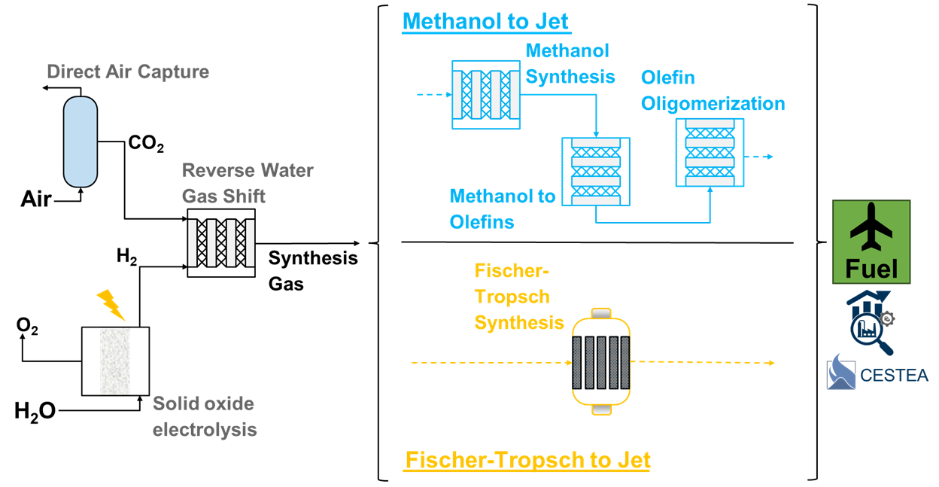
At the Chair of Energy Systems, we use process simulation to model a wide variety of processes in the context of energy conversion (e.g., steam power processes with water or other fluids) and chemical synthesis (e.g., renewable methanol synthesis). In practical work, process simulation is often used as a design aid, while in theoretical studies the focus is usually on comparing and optimizing different process configurations for the production of renewable chemicals and fuels. Figure 1 is taken from a published study by the chair, in which the production of sustainable aviation fuel from CO2 from the air and hydrogen from electrolysis is modeled and evaluated in terms of techno-economics [1]. The study focuses on a comparison of two thermochemical processes, Fischer-Tropsch-to-Jet and Methanol-to-Jet, in which a synthesis gas consisting of H2, CO, and CO2 is catalytically converted into liquid hydrocarbons.
CFD-Simulation
At the Chair of Energy Systems, computational fluid dynamics (CFD) plays a central role in the investigation of complex thermochemical processes. With the help of CFD, we model and analyze flow processes, heat and mass transfer, and chemical reactions. This enables us to gain detailed insights into physical and chemical processes that are often difficult to access experimentally.
Our work focuses on developing sound numerical models, validating them on the basis of experimental data from pilot plants, and finally transferring the findings to real plants. The focus is on simulating gasification and combustion processes in various reactor types. We consider both the gas-side reaction processes and the conversion behavior of solid particles such as biomass or residues. By coupling fluid mechanics, reaction kinetics, and particle modeling, we can precisely investigate the interactions between the gas phase and solid fuels. The models developed can be used, for example, to optimize industrial reactor designs and reduce pollutant emissions from real plants.
Examples of use:


Further simulation expertise lies in the area of ash behavior in entrained-flow reactors, fluidized bed modeling, and methanol synthesis in membrane reactors.
In the supplementary lecture “CFD Simulation of Thermal Processes,” students can learn the basics of numerical flow simulation and apply their knowledge to thermochemical processes.
Projects:
Contact:
Vincent Eyberg, Johannes Haimerl, Sebastian Wilhelm
References:
[1] Eyberg, V.; Dieterich, V.; Bastek, S.; Dossow, M.; Spliethoff, H.; Fendt, S.: Techno-economic assessment and comparison of Fischer–Tropsch and Methanol-to-Jet processes to produce sustainable aviation fuel via Power-to-Liquid. Energy Conversion and Management, 2024, doi: https://doi.org/10.1016/j.enconman.2024.118728