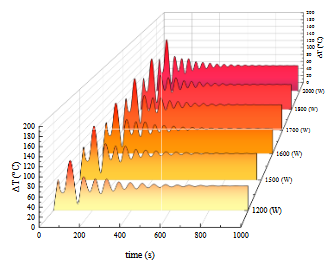
The focus of the Institute of Nuclear Engineering
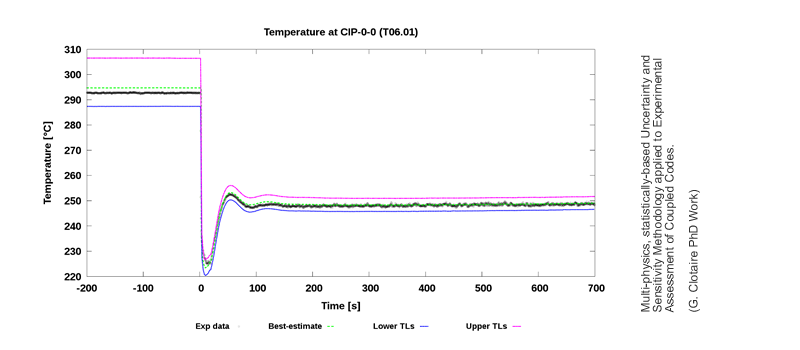
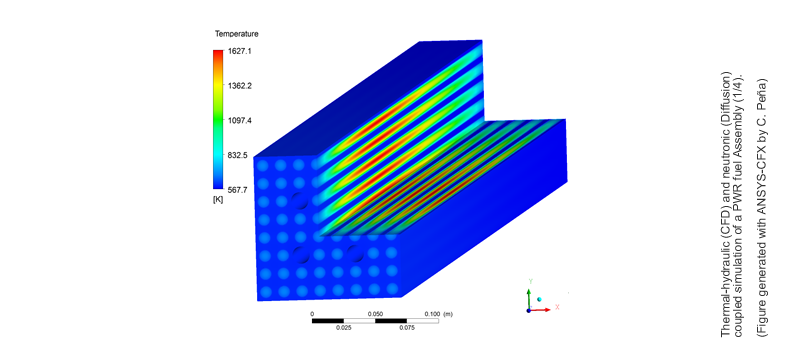
The research in nuclear safety carried out at the Institute focuses on the development and applications of methodologies to support the safe operation of nuclear reactors. The methodologies are based on a multi-physics approach which combines computer codes capable of detailed simulation of different important physical processes that determine the behavior of nuclear systems. Computational fluid dynamics (CFD) codes such as ANSYS-CFX and OpenFOAM are coupled in real time with detailed neutronic description of the core behavior provided by state-of-the-art multi-dimensional time-dependent neutronic programs such as PARCS. The detailed local description obtained of the thermal-hydraulics and neutron flux distribution can be used for full system simulation analysis with codes such as TRACE and ATHLET. In 2015, this research line has been carried out through projects which focus on the development of uncertainty and sensitivity methodologies for multi-physics applications to the assessment of computer codes in the context of liquid metal fast reactors; the development of an advanced model for turbine modeling based on parameter estimation techniques and online sensitivities; the completion of PhD thesis on the simulation of condensation induced Water-hammers and on.
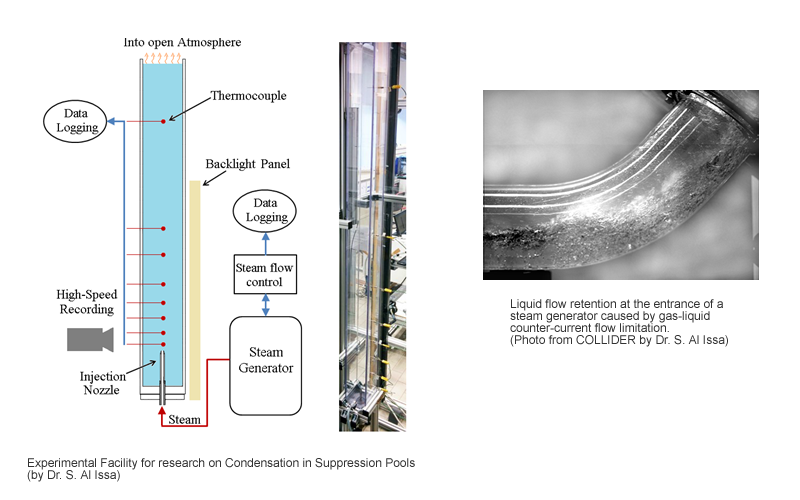
The Institute has built in the past four years an experimental laboratory for two-phase thermal-hydraulic research. A trend for increasing detail in the predictions of thermal-hydraulic coolant and moderator behavior in nuclear safety research is widespread in the world, and CFD codes fundamental tools in this respect. But their performance in nuclear safety applications for current and future reactor designs needs to be thoroughly assessed before their predictions can be accepted by the nuclear regulatory authorities. The facility at the Institute deals with two very important two phase flow phenomena, such as Counter current flow limitations (COLLIDER) and steam condensation (SCUBA). Both facilities can be flexibly reconfigured and in the course of a PhD work finished in 2015, have been equipped with advance measurement optically-based techniques for the characterization of two-phase interfacial phenomena. Additionally in 2015 a new facility has been built to study the condensation phenomena in suppression pools in collaboration with the Polytechnic University of Madrid.
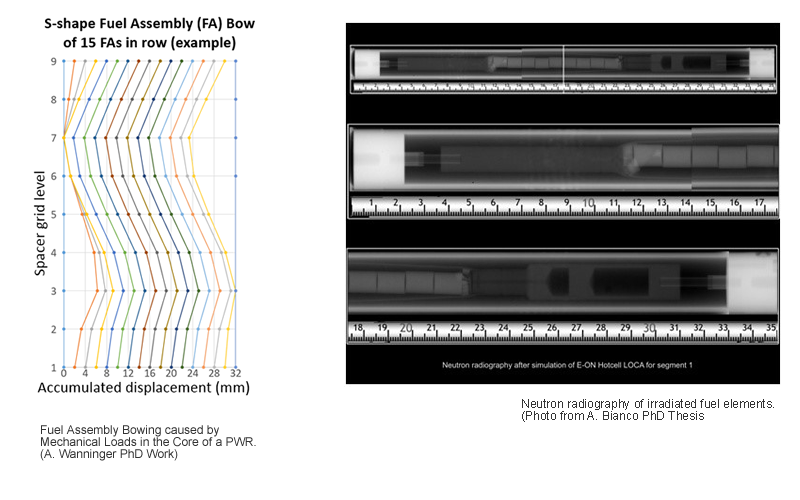
Fuel Behavior Analysis is a very important part of nuclear safety research, because the neutronic, thermal and mechanical performance of nuclear fuel decisively influences the safe and economical operation of nuclear reactors. The research activities have continued on the modelling of fuel and in the validation of computer codes that simulate its behavior under a wide range of operating and off-operating conditions. Thus, a project has focused on the investigation of the long-term creep deformation of PWR (Pressurized Water Reactor) fuel assemblies (FA), commonly known as FA bow, by using the Finite Element Method. The research on new fuel types has developed a new version of the fuel performance code TRANSURANUS, in collaboration with the Institute for Transuranic elements (ITU) in Karlsruhe, for thorium-based fuels ((Th,Pu)O2 and (Th,U)O2) including the complex phenomenon of fission gas release. Collaboration of the Institute with the CEA and E.On has produced two completed PhDs on LOCA behavior of highly-burn-up fuel, coupling of TRANSURANUS with the neutronics code DYN3D and the on.going PhD work in the behavior of new fuel materials in LWRs.
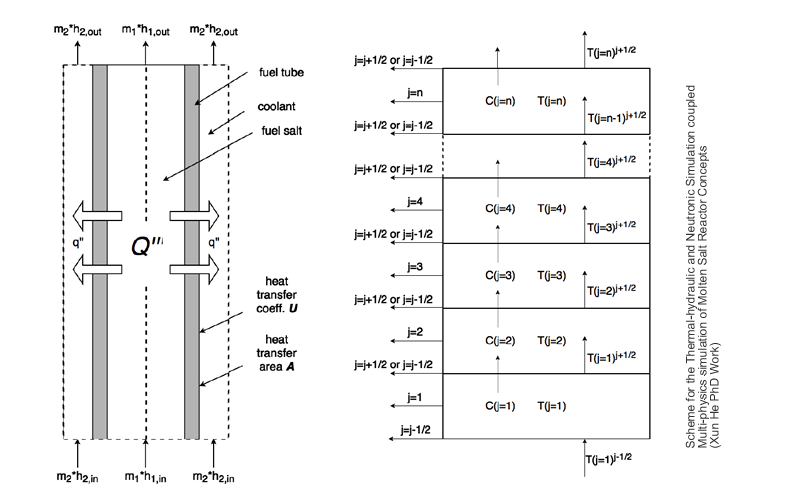
The Dual Fluid Reactor (DFR) is a new concept of nuclear systems based on the Molten Salt Reactor (MSR) design; one of the Generation IV reactor types currently under development. It has been conceived by the Institute of Solid Matter Physics (IFK) in Berlin and has the innovative feature of using a second molten metal as coolant. This configuration possesses many advantages with respect to the MSR and to other current and advanced reactor concepts, which have the potential to make the DFR a competitive reality in the future. Its ability to destroy the long-lived minor-actinides in burnt fuel and its extremely efficient use of nuclear fuel resources are two fundamental characteristics for its attractiveness. The Institute has been involved in this design for three years, in collaboration with the IFK, and has performed development and analysis work in the context of two PhD projects that are part of the multi-physics line of research described above, but applied to advanced reactor concepts. Two coupled computer analysis systems based on the codes ATHLET, TRACE-PARCS and SERPENT (Monte Carlo transport code) have been developed which are capable of detailed design optimization and safety analyses of neutronic and thermal-hydraulic aspects of the DFR and of any fluid core based nuclear system.
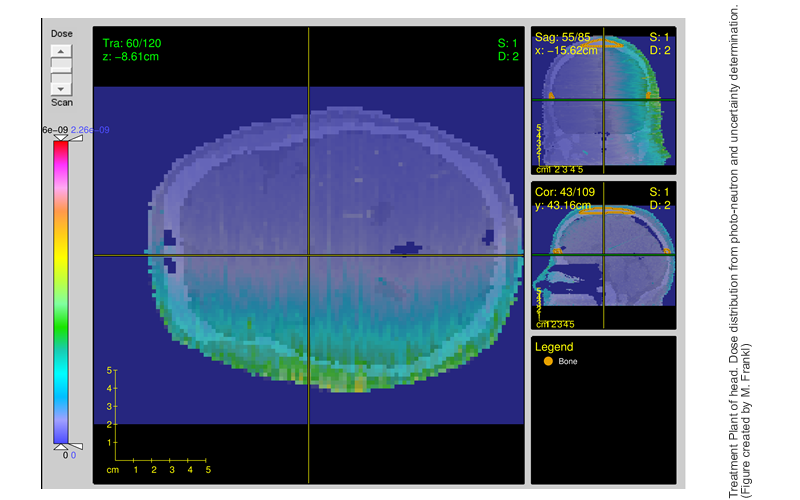
An important area on nuclear engineering is related to the development of medical applications of radiation. Radio-diagnostics and Radio-therapy are modern tools at the disposal of medical professionals that allow more precise diagnostics of many illnesses, the research of metabolic activity and the palliative or curative treatment of a wide variety of tumors. Modern radiotherapy procedures make an intense use of advanced computer programs to calculate dose distributions of photons, electrons and neutrons in treatment planning before the actual irradiation, so that doctors can better estimate the outcome of the therapy. Monte-Carlo based methods for particle transport are in the forefront of the most advanced therapy techniques. At the Institute, we develop methodologies based on these methods that can take into account the uncertainties associated and produce more accurate estimates of dose distributions. They can contribute to better treatment plants being deliver to patients.
Base 2nd-generation high-temperature superconducting REBCO-coated conductors to design and develop magnets suitable for high-magnetic-field stellarators, enabling stable and sustained nuclear fusion energy output. The research background focuses on global energy shortages and environmental pollution issues, highlighting nuclear fusion's significant potential as a clean and safe energy source.
Emerging high-temperature superconductors, particularly REBCO coated conductors, have transformed the landscape of both fusion and propulsion technologies. Unlike conventional low-temperature superconductors, HTS materials remain superconducting at magnetic fields exceeding 20 or even 30 teslas, while operating at elevated cryogenic temperatures above 20 K. This enables compact, durable, and high-power magnet systems that were previously impractical or impossible.

Molten salts, due to their unique advantages in thermal stability and high operating temperatures, have become a promising option for sustainable energy solutions globally.
However, there has long been an issue with the separation in the research for the energetic application of molten salts between nuclear and non-nuclear fields.
This research bridges the gap between research areas by proposing and implementing an approach to expand the nuclear simulation code in different domains, and eventually establishes a unified analysis platform for diverse advanced energy systems.
It creates a pioneering analysis platform across diverse energy systems, centered around modeling and simulation of thermophysical properties for molten salts.
The outcome of this research unifies the safety analysis framework across systems and provides a new perspective as a guiding principle for future studies across a broader range of salt-based energy technologies.