
CoConut2.0: Cell-cell interaction in a synthetic co-culture – PHA production from sunlight and CO2 in an artificial co-culture between Synechococcus elongatus and Pseudomonas putida
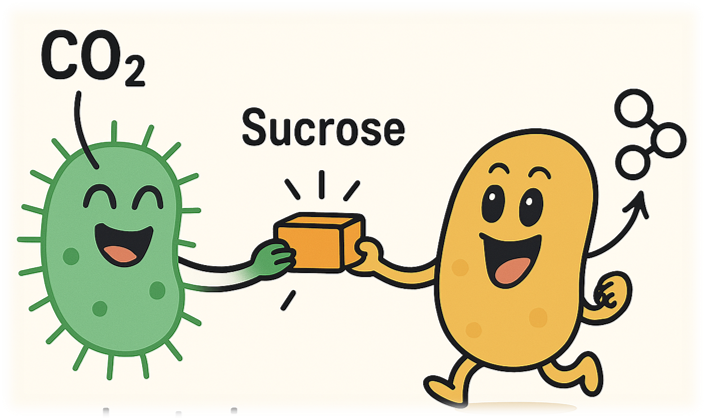
The ongoing climate crisis is one of the most pressing challenges of our time, with industrial greenhouse gas emissions being a major contributor to global warming. Given the urgency to reduce industrial emissions, innovative solutions for repurposing these gases are becoming increasingly important. One promising approach is to integrate them into sustainable bioprocesses, as realized with our photoheterotrophic co-culture: Under salt stress, the cyanobacterium Synechococcus elongatus (S. elongatus) PCC 7942 cscB (provider) converts light and CO₂ into sucrose. Secreted into the medium, this disaccharide serves as sole carbon source for the soil bacterium Pseudomonas putida (P. putida) EM178 attTn7::cscRABY (producer) to synthesize polyhydroxyalkanoates (PHAs), biodegradable alternatives to fossil-based plastics. The proof of concept and its successful optimization were demonstrated in former projects supervised by Dr.-Ing. Hannes Löwe and Dr. Ing. Franziska Pia Kratzl.
In the current project, the major goal is to harness the sustainable character of the co-culture to establish a universal platform process for environmentally friendly bioproduction. More specifically, this means shifting the focus from exclusive PHA production toward a flexible co-culture system capable of synthesizing diverse target compounds. While S. elongatus PCC 7942 cscB continues to act as carbon source provider, the expansion of the product spectrum is enabled by the inherent metabolic versatility of P. putida. The production host will be flexibly equipped to synthesize the desired products by exchanging biosynthetic modules.
For further process optimizations, a population model is being developed to quantitatively describe the dynamic behavior of the co-culture and predict optimal growth and production conditions. The model will also enhance comparability across the platform, as identical parameters can be applied throughout the entire product range. This will allow systematic tuning of process conditions to achieve maximum yields.
In addition, investigating metabolic interconnections and potential mutual effects between both partners will deepen our existing understanding of the cell-cell interactions within the microbial consortium.
Altogether, the synergy of experimental work and mathematical modeling will advance the co-culture into a versatile and robust platform for diverse biotechnological applications.
Project supervisor: M.Sc. Luisa Klein
Project start date: 01.02.2024